The summer school of Tallinn University “Experimental Interaction Design: Physiological Computing Technologies for Performative Arts.”
Throughout its history, humanity could not make a step forward without a qualitative leap. We assume that the next of these leaps will happen in the area of exchange of emotions.
Presumably, during the first stage, people will learn to directly exchange emotions with each other. As a result, all the perspectives on all the events will become available to everybody. And thus, the mere concept of perspective will become obsolete, as a shared comprehensive vision will emerge.
During the second stage, the emotional exchange will also include animals, plants, and non-organic objects (we assume at this stage it will be discovered that they also have emotions). After this all-absorbing emotional field appears, there will be no more individual feelings. During the third stage, humans and all other creatures will turn into post-plasma, which will absorb both the past and the present. The concept of time and space will disappear. Everyone will be everything and at the same time — nothing.
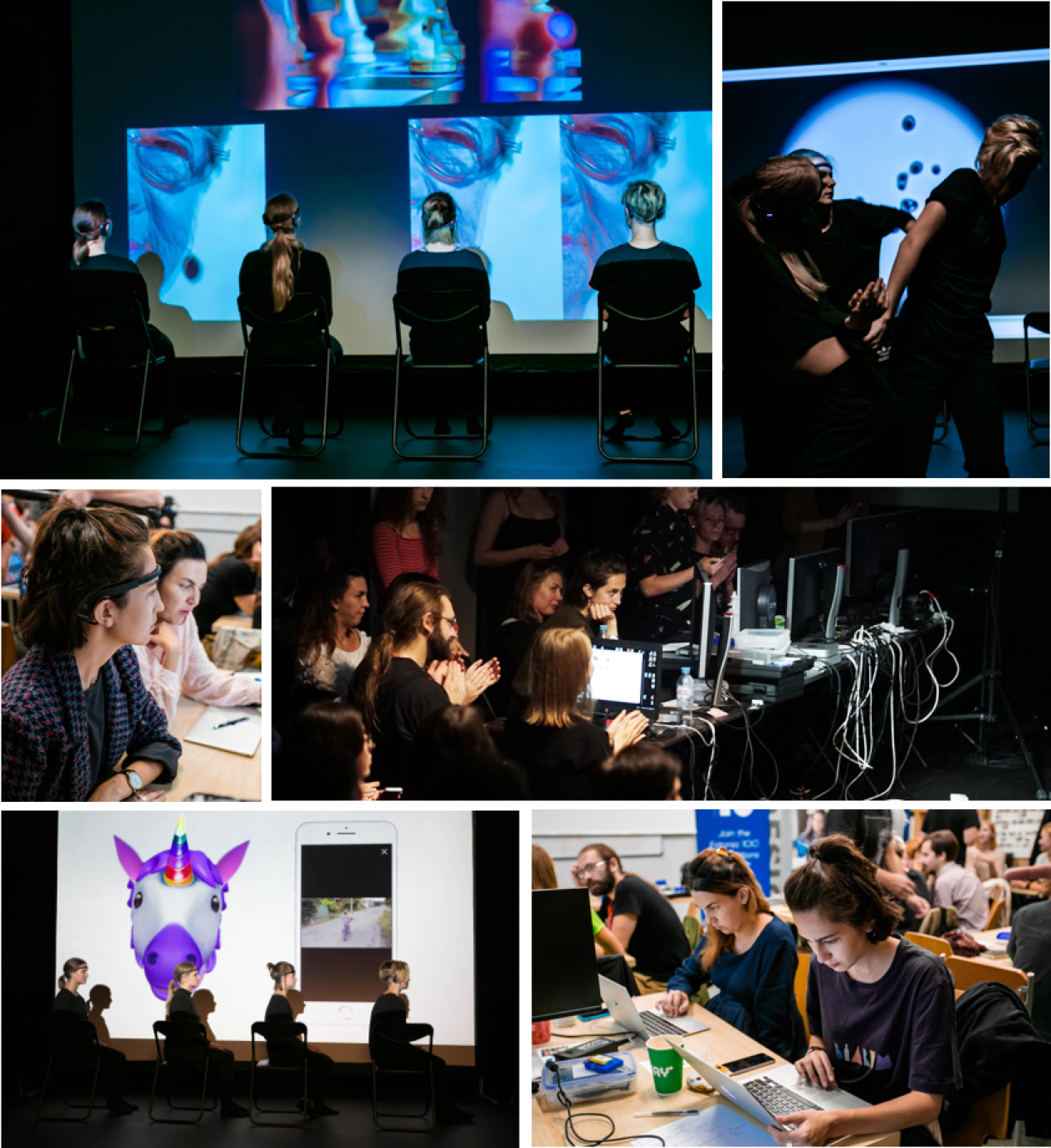
This performance is a peek at the first stage. It presents the exchange of emotions between four human units using a human-computer interface. Participants of the performance found partners for exchanging their emotions with a specially-created mobile app (“Brain Tinder”).
During the performance the audience could see how different memories produced emotions in real time (this was done with the help of Muse headband interfaces). And how the recursion happened when these emotions started producing new emotions.
This performance was created by a team of four people. My role included: coming up with the concept, filming and producing video, recording audio, designing the “Brain Tinder” mobile app, setting up the Muse interfaces.